


Culinary
Dec. 14th, 2025 06:30 pm![[personal profile]](https://www.dreamwidth.org/img/silk/identity/user.png) oursin
oursinLast week's bread held out fairly well until it did a variety of mould-related activity. There were still some rolls left, fortunately.
Friday night supper: Gujerati khichchari (with cashew nuts) which I do not seem to have made for absolute yonks.
Saturday breakfast rolls: brown grated apple: Light Spelt flour, molasses, a touch of ginger (this didn't really come through, probably overpowered by the molasses): rose like absolute whoah.
Today's lunch: the smoked haddock and pulses thing - smoked haddock loin fillets baked in cream + water with bay leaf, mace and 5-pepper blend, flaked and then layered with bottled black beans (would buy again), some of the cooking liquid added, top sprinkled with panko crumbs and baked in moderate oven for c. 40 minutes, served with baked San Marzano tomatoes, and slow-cooked tenderstem broccoli, finished with lime, some of which seemed less tenderstemmed than one might have expected.
Wishing . . .
Dec. 14th, 2025 08:59 amsartorias(no subject)
Dec. 14th, 2025 10:37 amskygiantsThe heroine of Rooftoppers is orphan Sophie, found floating in a cello case the English Channel after a terrible shipwreck and adopted by a charming eccentric named Charles who raises her on Shakespeare and Free Spirited Inquiry. Unfortunately the English authorities do not approve of children being raised on Shakespeare and Free Spirited Inquiry, so when they threaten to remove Sophie to an orphanage, Charles and Sophie buy themselves time by fleeing to Paris in an attempt to track down traces of Sophie's parentage.
Sophie is stubbornly convinced she might have a mother somewhere out there who survived the shipwreck! Charles is less convinced, but willing to be supportive. On account of the Authorities, however, Charles advises Sophie to stay in the hotel while he pursues the investigation -- but Sophie will not be confined! So she starts pursuing her own investigations via the hotel roof, where she rapidly collides with Matteo, an extremely feral child who claims ownership of the Paris roofs and Does Not Want want Sophie intruding.
But of course eventually Sophie wins Matteo over and is welcomed into the world of the Rooftoppers, Parisian children who have fled from orphanages in favor of leaping from spire to steeple, stealing scraps and shooting pigeons (but also sometimes befriending the pigeons) and generally making a self-sufficient sort of life for themselves in the Most Scenic Surroundings in the World. The book makes it quite clear that the Rooftoppers are often cold and hungry and smelly and the whole thing is no bed of roses, while nonetheless fully and joyously indulging in the tropey delight of secret! hyper-competent! child! rooftop! society!!
The book as a whole strikes a lovely tonal balance just on the edge of fairy tale -- everything is very technically plausible and nothing is actually magic, but also, you know, the central image of the book is a gang of rooftop Lost Kids chasing the haunting sound of cello music over the roof of the Palais de Justice. The ending I think does not make the mistake of trying to resolve too much, and overall I found it a really charming experience.
200 Significant Science Fiction Books by Women, 1984–2001, by David G. Hartwell
Dec. 14th, 2025 09:05 amjames_davis_nicoll( Read more... )
Cold War in a Country Garden (Dilke, volume 1) by Lindsay Gutteridge
Dec. 14th, 2025 08:46 amjames_davis_nicoll
One very small step for a man, one giant leap for Her Majesty's Government.
Cold War in a Country Garden (Dilke, volume 1) by Lindsay Gutteridge
After some digging
Dec. 13th, 2025 07:12 pmjames_davis_nicollWhat, to absolutely EVERYONE???
Dec. 13th, 2025 04:32 pmoursinI think this is an absolutely terrible idea, and that they should be giving book tokens, and, okay, maybe recommendations, but letting people choose their books:
30 authors on the books they give to everyone
I am in particular stunned by the choices of Some People, e.g. Colm Tóibín's Christmas Downer:
There is a book I buy as a present that never goes out of fashion. It is The Good Soldier by Ford Madox Ford.... the extraordinary plot creeps up and bites you before you know where you are. The narrative curls and twists; the narrator knows too much or too little. But at some point the appalling and ingenious nature of the treachery – what is called “cheating” nowadays – becomes apparent and you feel that you have been let in on some intriguing and explosive secret. It is perfect, thus, for Christmas.
I am also beswozzled by what Tessa Hadley considers comfort reading: Rumer Godden??? Okay, some of her works fall into that category, but on the whole I would not consider the ones she does name - The River in particular - exactly comforting.
Much as I love them, I would not press into anyone's hands Middlemarch, The Fountain Overflows, Cold Comfort Farm or The Pursuit of Love, urging that they they must read this.
I am reminded of GB Shaw's rewrite of the Golden Rule, about not doing to others as you would be done by, as tastes differ.
Take it away, Sly and the Family Stone!
(no subject)
Dec. 13th, 2025 10:41 amskygiantsAs a book, Paris in Ruins has a bit of a tricky task. Its argument is that the miserable events in Paris of 1870-71 -- double siege, brutal political violence, leftists and political reformers who'd hoped for the end of the Glittering and Civilized but Ultimately Authoritarian Napoleon III Empire getting their wish in the most monkey's paw fashion imaginable -- had a lasting psychological impact on the artists who would end up forming the Impressionist movement that expressed itself through their art. Certainly true! Hard to imagine it wouldn't! But in order to tell this story it has to spend half the book just explaining the Siege and the Commune, and the problem is that although the Siege and the Commune certainly impacted the artists, the artists didn't really have much impact on the Siege and the Commune ... so reading the 25-50% section of the book is like, 'okay! so, you have to remember, the vast majority of the people in Paris right now were working class and starving and experiencing miserable conditions, which really sets the stage for what comes next! and what about Berthe Morisot and Edouard Manet, our protagonists? well, they were not working class. but they were in Paris, and not having a good time, and depressed!' and then the 50-75% section is like 'well, now the working class in Paris were furious, and here's all the things that happened about that! and what about Berthe Morisot and Edouard Manet, our protagonists? well, they were not in Paris any more at this point. But they were still not having a good time and still depressed!'
Sieges and plagues are the parts of history that scare me the most and so of course I am always finding myself compelled to read about them; also, I really appreciate history that engages with the relationship between art and the surrounding political and cultural phenomena that shapes and is shaped by it. So I appreciated this book very much even though I don't think it quite succeeds at this task, in large part because there is just so much to say in explaining The Siege and The Commune that it struggles sometimes to keep it focused through its chosen lens. But I did learn a lot, if sometimes somewhat separately, about both the Impressionists and the sociopolitical environment of France in the back half of the 19th century, and I am glad to have done so. I feel like I have a moderate understanding of dramatic French upheavals of the 1860s-80s now, to add to my moderate understanding of French upheavals in the 1780s-90s (the Revolution era) and my moderate understanding of French upheavals in the 1830s-40s (the Les Mis era) which only leaves me about six or seven more decades in between to try and comprehend.
Huh
Dec. 13th, 2025 09:39 amjames_davis_nicollAside from Larry Correia, are there any big name Baen authors who debuted at Baen, after Jim Baen's death?
(So, Tim Powers wouldn't count because he debuted not at Baen and also long before JB died)
I got three names: Chuck Gannon, Jason Cordova and Mike Kupari. Gannon actually debuted at Baen in 1994 but only two (I think) short pieces, after which there was a long delay until his novels began appearing. I don't know the other two but SF is huge and it's perfectly possible for me to overlook BNAs. Still, granting all three, with LC that makes four... and in 2028, Toni Weisskopf will have been running Baen for as long as Jim Baen did.
This could, of course, be the natural consequence of the Del Monte approach.
[added later]

(no subject)
Dec. 12th, 2025 05:05 pmskygiantsshati described it as 'kind of like the Wayside School books' in a conversation about dark academia, a description which I trusted implicitly because shati always describes things in helpful and universally accepted terms. Anyway, so Vita Nostra is more or less a horror novel .... or at least it's about the thing which is scariest to me, existential transformation of the self without consent and without control.
At the start of the book, teenage Sasha is on a nice beach vacation with her mom when she finds herself being followed everywhere by a strange, ominous man. He has a dictate for her: every morning, she has to skinny-dip at 4 AM and swim out to a certain point in the ocean, then back, Or Else. Or Else? Well, the first time she oversleeps, her mom's vacation boyfriend has a mild heart attack and ends up in the ER. The next time ... well, who knows, the next time, so Sasha keeps on swimming. And then the vacation ends! And the horrible and inexplicable interval is, thankfully, over!
Except of course it isn't over; the ominous man returns, with more instructions, which eventually derail Sasha off of her planned normal pathway of high school --> university --> career. Instead, despite the confused protests of her mother, she glumly follows the instructions of her evil angel and treks off to the remote town of Torpa to attend the Institute of Special Technologies.
Nobody is at the Institute of Special Technologies by choice. Nobody is there to have a good time. Everyone has been coerced there by an ominous advisor; as entrance precondition, everyone has been given a set of miserable tasks to perform, Or Else. Also, it's hard not to notice that all the older students look strange and haunted and shamble disconcertingly through the dorms in a way that seems like a sort of existential dispute with the concept of space, though if you ask them about it they're just like 'lol you'll understand eventually,' which is not reassuring. And then there are the actual assignments -- the assignments that seem designed to train you to think in a way the human brain was not designed to think -- and which Sasha is actually really good at! the best in her class! fortunately or unfortunately .... but fortunately in at least this respect: everyone wants to pass, because if you fail at the midterm, if you fail at the finals, there's always the Or Else waiting.
AND ALSO all the roommates are assigned and it's hell.
Weird, fascinating book! I found it very tense and propulsive despite the fact that for chapters at a time all that happens is Sasha doing horrible homework exercises and turning her brain inside out. I feel like a lot of magic school books are, essentially, power fantasies. What if you learned magic? What if you were so good at it? Sasha is learning some kind of magic, and Sasha is so good at it, but the overwhelming emotion of this book is powerlessness, lack of agency, arbitrary tasks and incomprehensible experiences papered over with a parody of Normal College Life. On the one hand Sasha is desperate to hold onto her humanity and to remain a person that her mother will recognize when she comes home; on the other hand, the veneer of Normal College Life layered on top of the Institute's existential weirdness seems more and more pointless and frustrating the further on it goes and the stranger Sasha herself becomes. I think the moment it really clicked for me is midway through Sasha's second year, when ( spoilers )
The Ministry for the Future, by Kim Stanley Robinson
Dec. 12th, 2025 01:45 pmrachelmanija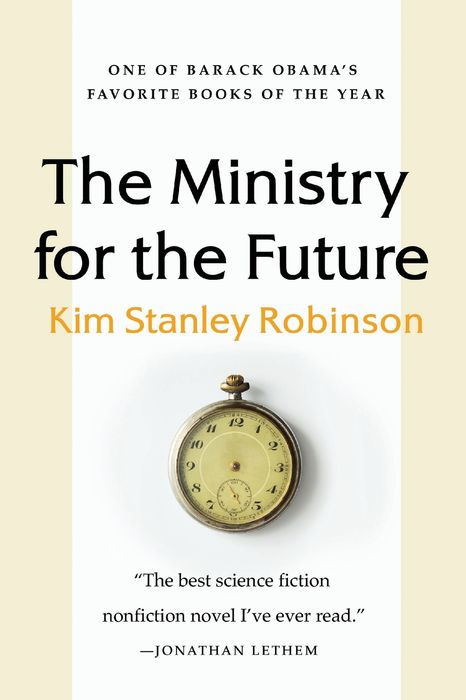
After a wet-bulb heat wave kills thousands in India, the UN forms an organization, the Ministry for the Future, intended to deal with climate change on behalf of future generations. They're not the only organization trying mitigate or fight or adapt to climate change; many other people and groups are working on the same thing, using everything from science to financial incentives to persuasion to terrorism.
We very loosely follow two very lightly sketched-in characters, an Irish woman who leads the Ministry for the Future and an American man whose life is derailed when he's a city's sole survivor of the Indian wet-bulb event, but the book has a very broad canvas and they're not protagonists in the usual sense of the word. The book isn't about individuals, it's about a pair of phenomena: climate change and what people do about it. The mission to save the future is the protagonist insofar as there is one.
This is the first KSR book I've actually managed to finish! (It's also the only one that I got farther in than about two chapters.) It's a very interesting, enlightening, educational book. I enjoyed reading it.
He's a very particular kind of writer, much more interested in ideas and a very broad scope than in characters or plot. That approach works very well for this book. The first chapter, which details the wet-bulb event, is a stunning, horrifying piece of writing. It's also the closest the book ever comes to feeling like a normal kind of novel. The rest of it is more like a work of popular nonfiction from an alternate timeline, full of science and economics and politics and projects.
I'm pretty sure Robinson researched the absolute cutting edge of every possible action that could possibly mitigate climate change, and wrote the book based on the idea of "What if we tried all of it?"
Very plausibly, not everything works. (In a bit of dark humor, an attempt to explain to billionaires why they should care about other people fails miserably.) Lots of people are either apathetic or actively fighting against the efforts, and there's a whole lot of death, disaster, and irreparable damage along the way. But the project as a whole succeeds, not because of any one action taken by any one group, but because of all of the actions taken by multiple groups. It's a blueprint for what we could be doing, if we were willing to do it.
The Ministry for the Future came out in 2020. Reading it now, its optimism about the idea that people would be willing to pull together for the sake of future generations makes it feel like a relic from an impossibly long time ago.
There Is No Antimemetics Division by Qntm
Dec. 12th, 2025 04:31 pmlightreads4/5. A short novel about what it would be like to be an organization fighting anti-memes (powerful eldritch somethings that can effectively erase information from the universe, including from human memory). How do you fight a war for humanity when you keep forgetting a war is happening at all?
A very interesting mechanism of a book. I enjoyed watching its strangely-shaped gears catch one to the next, partly because this is the sort of story that my brain would not have come up with given several centuries of work. Not just the story itself, but the entire odd structure that makes it go. I do think I fundamentally disagree with one of this books premises about how human beings work, but sure, okay, I’m willing to go with the idea that the people who work at this particular organization are odd ducks who will, for example, have an entire decade of life scooped out of their head by a cosmic horror and who will just kinda shrug and go about calmly reconstructing their life from the evidence left behind.
I will say as a point of flavor more than a warning: this book has that particular approach to character where people are extremely unembodied. Indeed, you could be forgiven for picturing the entire cast as brains in a jar that go about acting on the world and on each other without much affect at all. People do have internal lives, but we glimpse them at odd angles and through narrow pinholes, like when we only get to know about a marriage when one of the spouses has forgotten the other and reads the surveillance reports on them. It’s all definitely a vibe, and not my style, but here it works.
Content notes: Cosmic horror, other kinds of creeping horror of knowing you’ve forgotten something terrifying, violence.
Thundering up over the horizon....
Dec. 12th, 2025 08:52 pmoursinSuddenly it seems like Christmas is more imminent than I thought - I was going, oh, it is only the beginning of December, and now we are nearly 2 weeks in and aaaaargh.
Anyway, I have managed to get off the book tokens for the great-nieces and nephews - I was waiting on my sister coming back to let me know that, yes, they are all still readers, and then looked again at her email in which she said, would let me know if not....
So I got on to that and I had clearly erased from memory how immensely tiresome Waterstones site is should you want to purchase physical gift cards for several people, you have to make a separate purchase for each one, moan groan, and quite soon reached point where credit cards went 'we are sending you OTP' as you put in details yet another time.
Am feeling a bit generally fratchy today after a night troubled with resurgence of hip issue - probably due to a certain amount of standing about at Institution of Which I Am Honoured to Be A Fellow's Party yestere'en.
Had a moderately agreeable time and pleasant conversation but am still irked that the email issue remains unresolved.
Also, having determined to ring opticians to confirm appointment for dilation test - after a very satisfactory, insofar as holding one's head in awkward positions and having lights flashed in one's eyes can be thus designated, eye-test on Wednesday, at which it was determined I did not need new glasses, hooray, hooray, person I was dealing with right at the end looked at my notes and asked how long it was since they did a dilation test, which resulted in booking me in for a week's time. However, did not get any confirmation, odd I thought since they had been inundating me with texts and emails reminding me of the eye-test. So I was going to ring them but then they rang, going ooops, we are actually closed that day for training, can we reschedule. So rescheduled.
Merry Christmas for Poilievre!
Dec. 12th, 2025 01:26 pmjames_davis_nicollEmbattled CPC leader's Christmas card list gets one name shorter.
Looking Back at the Work of John Varley, 1947-2025
Dec. 12th, 2025 12:12 pmjames_davis_nicoll
Where to start reading — or rereading — Varley's many series and stories.
Looking Back at the Work of John Varley, 1947-2025
The Wayfinder by Adam Johnson
Dec. 12th, 2025 09:03 amjames_davis_nicoll
The visitors might be Bird Island's salvation or simply the next step in its doom.
The Wayfinder by Adam Johnson